If you picture Charleston living as a historic downtown home or a beach house near the water, you are only seeing part of the story. For some buyers, the real draw is space, privacy, and land that can support horses, hobby farming, or simply a quieter Lowcountry lifestyle. This guide walks you through what to look for, what questions to ask, and what makes Charleston acreage and equestrian properties different from a standard home search. Let’s dive in.
Why Charleston acreage stands apart
Charleston County’s planning framework treats rural land differently from more urban villages and towns. In practical terms, that means many acreage and equestrian properties are shaped by a county-level rural land use approach, not a neighborhood subdivision model.
That matters when you start comparing properties. A parcel may offer room to build, fence, ride, or expand, but what you can actually do depends on where the property sits and which rules apply.
Start with jurisdiction first
One of the first questions to answer is whether the property is in unincorporated Charleston County or inside the City of Charleston. For unincorporated parcels, Charleston County’s Zoning & Planning Department oversees the Zoning and Land Development Regulations.
If the property is inside the City of Charleston, the city uses a separate zoning ordinance. That difference can affect setbacks, permitted uses, parking, subdivision standards, and other development rules, so it is worth confirming early.
Where equestrian living shows up around Charleston
Charleston’s horse community is spread across the county’s lower-density areas, not concentrated in one single pocket. Official equestrian facilities and private boarding or training operations appear on Johns Island, in Ravenel, and in Huger.
For buyers, that creates options. You may want a horse-ready property close to established equestrian activity, or you may prefer acreage with room to create your own setup while still staying connected to trails, events, or training resources nearby.
What horse-ready property usually includes
Acreage alone does not make a property equestrian-ready. The more useful question is whether the land and improvements already support your intended use.
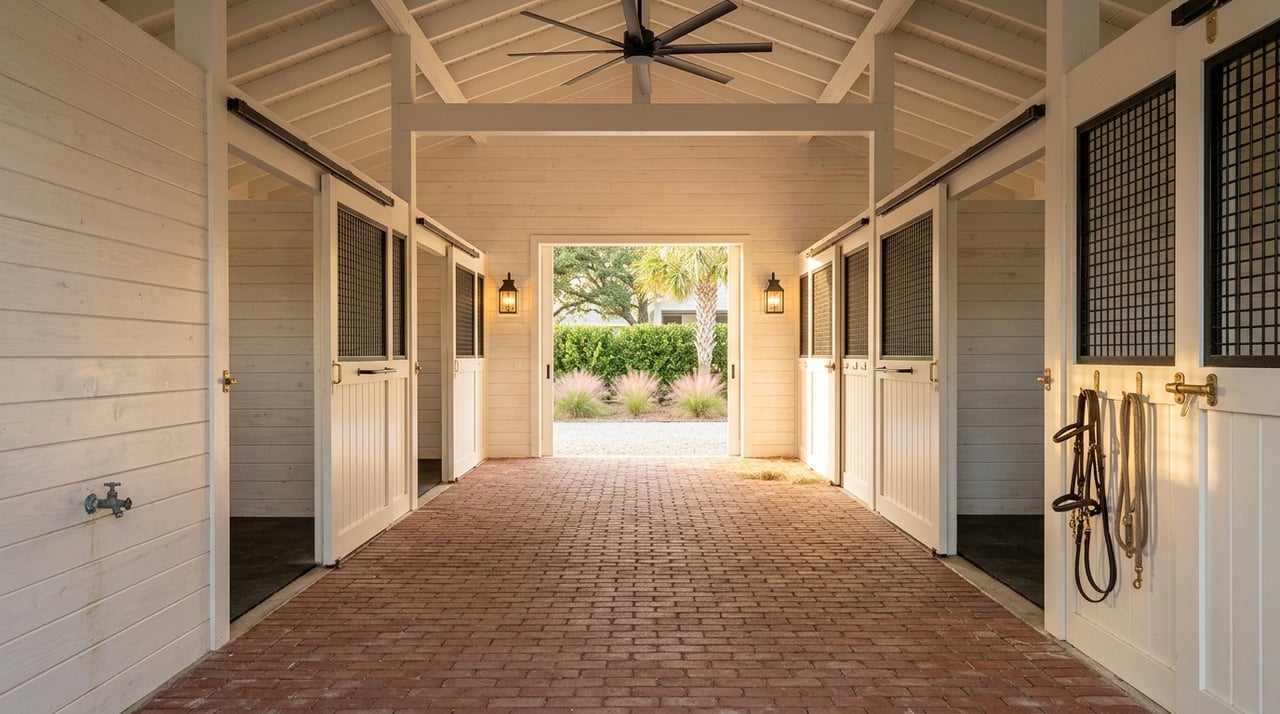
In the Charleston area, public and private horse facilities point to the features many buyers look for first. Common benchmarks include:
- Stalls
- Barns with water and electricity
- Turnout fields or pastures
- Fencing
- Show rings or arenas
- Lunging space
- Wash stations or wash racks
- Trailer parking
- Tack and feed storage
These features can help you tell the difference between a property that is ready now and one that may require meaningful site work.
Turnkey vs. build-out potential
Some properties will already have core equestrian infrastructure in place. Others may offer mostly raw land or a home with open acreage, but no horse improvements yet.
That distinction matters for both budget and timeline. If you need fencing, barn utilities, drainage work, a driveway extension, or an arena area, those improvements may trigger county review depending on the site and scope of work.
Nearby facilities help set expectations
Looking at established equestrian facilities around Charleston can give you a practical benchmark. These properties show the kind of infrastructure serious horse owners often value.
For example, Mullet Hall Equestrian Center on Johns Island includes two 98-stall barns, temporary stall pads, five show rings, horse-washing stations, open grass fields, camping hook-ups, and 20 miles of trails. Private facilities in the region also highlight sought-after amenities such as covered and outdoor arenas, climate-controlled tack and feed rooms, multiple pastures, trailer parking, and fully fenced layouts.
You do not need a property of that scale, of course. Still, comparing a listing to these local standards can help you judge whether a property truly fits your goals.
Trails and riding access near Charleston
For many buyers, the property itself is only half the equation. The other half is where you can ride, train, or compete nearby.
Johns Island County Park is one of the clearest examples of public equestrian access in the Lowcountry. The park offers 20 miles of casual, rider-friendly equestrian trails, and the trails are natural and unpaved, which fits the area’s rural riding experience.
Understand what public access does and does not include
It is important not to assume that trail access also means full horse services on-site. Mullet Hall Equestrian Center hosts horse shows, festivals, exhibitions, and trail riding, but it does not offer lessons, rentals, or boarding.
That detail can shape your home search. If you need boarding or training support, you may want to focus on acreage near private operations that provide those services.
Event and training access matters too
Charleston’s equestrian network supports more than casual riding. Mullet Hall continues to host active show programming, including a 2026 Low Country Dressage Classic prizelist with classes ranging from USDF Introductory through Grand Prix.
Private barns in the region also support training and boarding. Examples in the research include hunter/jumper training in Huger and boarding and training in Ravenel, which reinforces that Charleston-area equestrian living can connect to both recreation and organized competition.
How acreage living differs from in-town homes
If you are moving from downtown Charleston, Mount Pleasant, or another more typical residential setting, acreage living comes with a different checklist. The search is less about finishes and more about land use, access, infrastructure, and future flexibility.
City-of-Charleston zoning is generally shaped by tighter urban-form controls such as use categories, dwelling units, building heights, setbacks, parking, signs, and subdivision standards. Rural acreage parcels often involve a different planning framework and a different set of development questions.
Accessory structures can be a major factor
In Charleston County agricultural zoning districts, accessory structures can be allowed without a principal structure. In other districts, a principal structure generally must exist first.
That can be a major difference for buyers planning a barn, storage building, or other outbuilding. It is one more reason zoning review should happen before you assume a parcel fits your intended use.
Site work often needs closer review
On acreage, even practical improvements can carry permitting implications. Charleston County notes that zoning permits may be required for grading, filling, drainage work, roads or driveways, and fence installation.
The county’s stormwater program also requires a permit for land disturbance over 5,000 square feet in unincorporated areas. If you are planning to reshape fields, build out horse infrastructure, or improve access, these reviews can affect cost and timing.
Flood and drainage deserve extra attention
In the Lowcountry, flood and drainage review is essential for almost any property, and especially for acreage. FEMA maps help determine insurance requirements, but being outside a special flood hazard area does not automatically mean a property is free from drainage concerns.
The City of Charleston notes that properties can still face local drainage problems, unmapped floodplains, sea-level-rise effects, or other hazards. Charleston County also states that the greatest flood threat in the county area is storm surge from Atlantic hurricanes.
Ask deeper questions than the flood zone
When you evaluate acreage, look beyond the basic map label. You will want to understand how water moves across the site, whether low areas hold water, and whether planned improvements could affect stormwater review.
This can be especially important in certain parts of the county. Charleston County identifies West Ashley, James Island, and Johns Island as Stormwater Special Protection Areas, where development can face added stormwater criteria.
Tax questions may matter for some buyers
If you are considering a horse property, hobby farm setup, or land with agricultural use, tax treatment may come up during your due diligence. Charleston County states that property used for bona fide agricultural use to raise, harvest, store crops, or manage livestock may qualify for agricultural use assessment if the application is filed by the deadline.
That does not mean every acreage property will qualify. It does mean that buyers with agricultural or livestock-related plans should confirm eligibility directly with the county assessor as part of the process.
A smart Charleston acreage checklist
When you tour acreage or equestrian properties in the Charleston area, keep your review focused on function, not just appearance. A beautiful setting is important, but the real value often sits in what the land can support.
Here is a practical checklist to use:
- Confirm whether the property is in unincorporated Charleston County or inside the City of Charleston
- Review current zoning and how it affects horse use, outbuildings, fencing, and future improvements
- Check whether the site already has horse-ready infrastructure or needs added work
- Evaluate water, electricity, drainage, and driveway access to barns or future structures
- Review flood maps and ask about on-site drainage patterns
- Ask whether land disturbance, grading, fencing, or driveway work may need permits
- If the property is on Johns Island, James Island, or West Ashley, check whether added stormwater criteria may apply
- Consider proximity to trails, shows, boarding, or training depending on how you plan to use the property
- If agricultural use is part of your plan, confirm assessment rules with the county assessor
Why local guidance matters with niche property types
Acreage and equestrian properties often require a more detailed evaluation than a conventional home purchase. The right property is not just about acreage count. It is about zoning, access, stormwater, flood exposure, existing improvements, and how well the land matches your goals.
That is where experienced local guidance can make the process more efficient. With specialty property types like acreage, equestrian estates, and custom-build land, careful due diligence upfront can help you avoid expensive surprises later.
If you are exploring Charleston acreage, horse property, or land with custom-build potential, Jack Huguley offers locally rooted, high-touch guidance tailored to the details that matter most.
FAQs
What makes Charleston acreage properties different from standard homes?
- Charleston acreage properties often require more review of zoning, drainage, flood exposure, site access, and permitted improvements than a standard in-town home.
What should you check before buying an equestrian property in Charleston?
- You should confirm jurisdiction, zoning, fencing and barn potential, stormwater or land-disturbance requirements, flood and drainage conditions, and nearby access to trails, boarding, or training.
Where can you find equestrian trails near Charleston?
- Johns Island County Park offers 20 miles of natural, unpaved equestrian trails and is one of the few public equestrian trail systems in the Lowcountry.
Does Mullet Hall Equestrian Center offer boarding in Charleston County?
- No. Mullet Hall hosts horse shows, exhibitions, festivals, and trail riding, but it does not offer lessons, rentals, or boarding.
Why does zoning jurisdiction matter for Charleston land purchases?
- Zoning jurisdiction matters because unincorporated Charleston County parcels follow county regulations, while properties inside the City of Charleston follow the city’s separate zoning ordinance.
Can Charleston County acreage qualify for agricultural assessment?
- Charleston County says property used for bona fide agricultural use to raise, harvest, store crops, or manage livestock may qualify for agricultural use assessment if the application is filed by the deadline.